


In the days leading up to Easter I offered a deep discount on my first mystery, The Book of Answers to my clergy colleagues. It’s set during Holy Week, and involves a corpse that falls out of a hidden chamber in the basement of a church.
I hoped it would be a suitable treat for ministers, who often find the tail-end of Lent and the busy week leading up to the celebration of Easter to be a lot.
Happily, a number of clergy took me up on the offer, and I was able to arrange to have books sent directly to them. This led to conversations via email or Facebook Messenger with a few of them.
I made one of these new connections with Bob Mercer, who serves a United Church congregation in Lambton County, not far from where I live. In fact it’s close enough that I hope to take him out for coffee sometime.
At one point Bob told me that my book was next in his TBR (to be read) pile, after he finished one by Ian Rankin. I was honoured that my book was in such close proximity to one by one of the masters of crime writing. I haven’t read the one Bob was working through, so I asked him about the book.
Bob’s comments were so interesting and helpful that I asked him if he’d like to write a review. He said yes.
After reading his review I know I will be adding Saints of the Shadow Bible to my own TBR list.
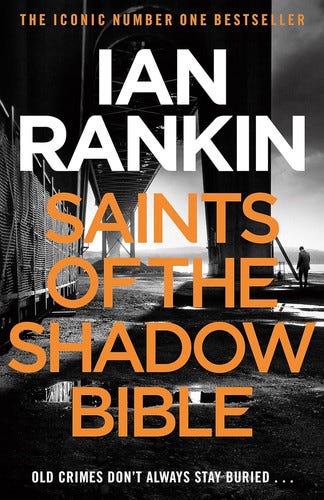
Bob Mercer’s Review of Ian Rankin’s “Saints of the Shadow Bible”
When Darrow asked me if I’d like to pen a few words about crime writer Ian Rankin’s 2013 novel (featuring the hardboiled and angry detective John Rebus), I felt compelled to point out that while we both shared a love of crime fiction, this was actually the first Rankin novel I’d read. I mean, I’d long heard of Mr. Rankin, but my tastes were more along the lines of Jeffery Deaver, Lee Child, and Karin Slaughter. Rankin’s novels were highly lauded by numerous critics, so when I finally had a chance to read one, I figured it was only right to do so.
I’m very glad I did.
I went into Saints of the Shadow Bible with no expectations, seeing as how I had no idea what Rankin’s Rebus stories were about. Didn’t take long to realize the novel’s settings are found in Scotland, a far cry from the overused seediness of New York’s Bowery or the drug-infested underbelly of glitzy Los Angeles. I’d visited Glasgow over 20 years ago, so being able to read of it was, in a way, like revisiting a long-lost cousin. I was glad that the Scottish vernacular wasn’t a problem to an English-speaker like myself; only a few words and phrases were slightly questionable, but then again, they only add to the flavour of Rankin’s beloved country.
Rebus is a maverick detective, a chain-smoking guy with a chip on his shoulder the size of the Isle of Staffa. He’d been demoted and now threatened with further slashes to his career, so he’s mightily pissed-off and really couldn’t care anymore just whose knickers he gets in a twist. He has nothing to lose, which only makes him more irritable. Yet Rebus also cares for the law and while skating near its fringes, he isn’t about to break it. In this respect, he’s a noble protagonist, even if caring for he and his well-being is a tad difficult for the reader.
The novel’s characters are also suspiciously watered-down with their language, which I found quite surprising. I mean, the language of some crime fiction writers can get saltier than a shipload full of Bostonian sailors (the aforementioned Karin Slaughter and the late Elmore Leonard are two such, which only makes their works grittier than most), but Rankin holds back to an extent that the reader is only vaguely aware that s/he hasn’t been fed a diet of cuss words, and for my money, that’s quite the feat! Unnecessary swearing aside, Rankin’s wordplay is like a subtle dance: a move here, a twirl there, a verbal riposte that sets up the next sequence of either action, reaction, or interaction. He makes you want to keep reading, and you actually feel like there’s something missing if you do have to set it aside, even just for the briefest of intervals. That’s a master at work, right there.
Rankin plots out the story with a deftness that only leads to a red herring... or does it? What difference does it make that a criminal’s autopsied corpse carried with it a lingering scent of whiskey? Yet Rebus works with the seemingly innocuous to guide the reader down yet another path of good, albeit stodgy detective work. This isn’t TV cop stuff where crimes are solved in an hour; this book takes deliberately extended and excruciatingly detailed police procedurals to their inevitable conclusions. Guns don’t have to be pulled every time a cop approaches a closed door; a guy like Rebus is more than aware that a tired, pissed-off, no-nonsense approach might be exactly what is needed to get the answers he wants, even as you can feel his anger coming to a slow boil.
I look back on this mini-review and I’m surprised that I was able to take all this from having read only one of Ian Rankin’s books! Clearly, he writes with a cold calculation as to what the reader should expect: a slow burn plotline with a satisfying ending. Would I read more from Mr. Rankin? Absolutely! I haven’t felt this way since reading my first Jeffery Deaver or Simon Kernick detective novels. So thank you, Ian Rankin.
What a great idea to invite reader participation! Only problem, now I feel the need to add to my very long TBR list with some Ian Rankin novels. I remember when I was an undergrad at UWindsor the priest at Assumption and I shared a love of murder mysteries. It seems those of us comfortable with the biggest Mystery also love to suss out the whys and wherefore of other kinds of mysteries. Thanks for stirring up in me a lovely few memories of days long past.